



Tournament operations
Pickleball Schedule for 8, 10 or 12 Teams
Three copy-ready schedules with courts, rest, pools and playoffs for a realistic tournament day.
In this guide
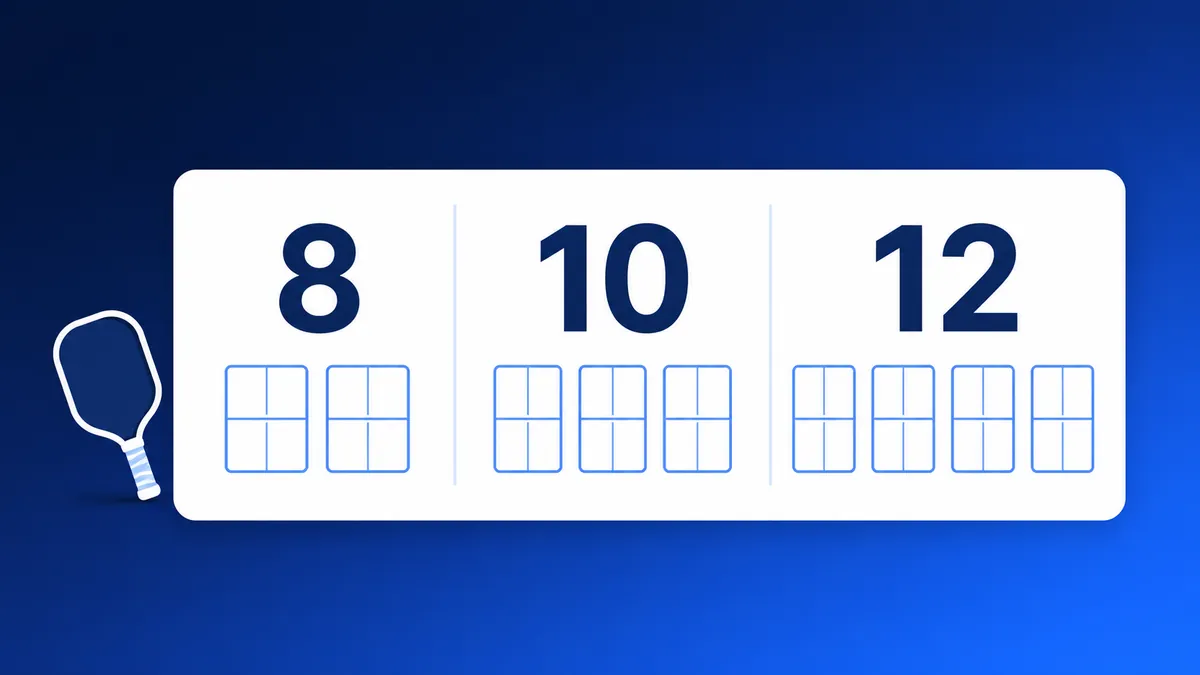
To build a pickleball tournament schedule, start with both team count and court count, then use a slot that includes play and turnover. The three templates below use 20-minute slots: 8 teams on 2 courts take 200 minutes; 10 teams on 3 courts take 220 minutes in the compact version or 280 minutes when rest is prioritized; 12 teams on 4 courts take 220 minutes. Those are planning assumptions, not a universal rule limit. Test them against your scoring format, officiating plan and expected level of play.
Compare the three schedules
| Teams | Courts | Pools | Total games | Slots | Duration |
|---|---|---|---|---|---|
| 8 | 2 | 2 × 4 | 15 | 10 | 3 hr 20 min |
| 10 | 3 | 2 × 5 | 23 | 11 or 14 | 3 hr 40 min or 4 hr 40 min |
| 12 | 4 | 4 × 3 | 19 | 11 | 3 hr 40 min |
The ten-team schedule offers two options. The compact version uses all three courts. The rest-first version keeps Court 3 available for warm-up, a replay or a delayed game; it takes longer but gives teams a full slot off between pool games.
The general round-robin scheduling guide explains the method. The grids below are ready to copy.
8 teams, 2 courts: two pools of four
The top two teams in each pool qualify for the semifinals.
| Slot | Court 1 | Court 2 |
|---|---|---|
| 1 | A1–A4 | A2–A3 |
| 2 | B1–B4 | B2–B3 |
| 3 | A1–A3 | A4–A2 |
| 4 | B1–B3 | B4–B2 |
| 5 | A1–A2 | A3–A4 |
| 6 | B1–B2 | B3–B4 |
| 7 | Rest and standings | Rest and standings |
| 8 | 1A–2B | 1B–2A |
| 9 | Rest | Final preparation |
| 10 | Final | — |
Each team receives three pool games. Alternating Pool A and Pool B gives 20 minutes off before the next game. The total is 12 pool games, two semifinals and one final.
10 teams, 3 courts: two options
Compact option: use all three courts
This version places all 20 pool games in seven slots. No team is double-booked, and no team plays in three consecutive slots. Some teams do play back to back.
| Slot | Court 1 | Court 2 | Court 3 |
|---|---|---|---|
| 1 | A4–A5 | B1–B2 | B4–B5 |
| 2 | A1–A5 | A2–A3 | B2–B3 |
| 3 | A3–A4 | B1–B5 | B3–B4 |
| 4 | A1–A4 | A2–A5 | B2–B5 |
| 5 | A1–A3 | B1–B3 | B2–B4 |
| 6 | A2–A4 | A3–A5 | B3–B5 |
| 7 | A1–A2 | B1–B4 | — |
| 8 | Standings and rest | Standings and rest | Standings and rest |
| 9 | 1A–2B | 1B–2A | — |
| 10 | Rest | Final preparation | — |
| 11 | Final | — | — |
The total is 23 games in 3 hours 40 minutes. Slot 8 protects rest before the semifinals, and Slot 10 protects the finalists. Choose this option when venue time is the main constraint and consecutive pool games are acceptable.
Rest-first option: keep one court in reserve
One team has a bye in every pool round. Pools A and B alternate to make the rest rule easy to follow; Court 3 remains an operational reserve.
| Slots | Court 1 | Court 2 | Court 3 |
|---|---|---|---|
| 1 / 2 | A2–A5, then B2–B5 | A3–A4, then B3–B4 | Reserve |
| 3 / 4 | A1–A5, then B1–B5 | A2–A3, then B2–B3 | Reserve |
| 5 / 6 | A1–A4, then B1–B4 | A5–A3, then B5–B3 | Reserve |
| 7 / 8 | A1–A3, then B1–B3 | A4–A2, then B4–B2 | Reserve |
| 9 / 10 | A1–A2, then B1–B2 | A4–A5, then B4–B5 | Reserve |
| 11 | Rest and standings | Rest and standings | Reserve |
| 12 | 1A–2B | 1B–2A | Reserve |
| 13 | Rest | Final preparation | Reserve |
| 14 | Final | — | Reserve |
The total is 20 pool games, two semifinals and one final. Every team receives four pool games, but the model takes 4 hours 40 minutes. Compare that number with the venue booking using How to Estimate Tournament Duration.
12 teams, 4 courts: four pools of three
This option prioritizes rest and an eight-team playoff. Each team receives two pool games, so state that guaranteed-game floor clearly during registration.
| Slot | Court 1 | Court 2 | Court 3 | Court 4 |
|---|---|---|---|---|
| 1 | A1–A2 | B1–B2 | C1–C2 | D1–D2 |
| 2 | Rest | Rest | Rest | Rest |
| 3 | A1–A3 | B1–B3 | C1–C3 | D1–D3 |
| 4 | Rest | Rest | Rest | Rest |
| 5 | A2–A3 | B2–B3 | C2–C3 | D2–D3 |
| 6 | Standings | Standings | Standings | Standings |
| 7 | 1A–2D | 1B–2C | 1C–2B | 1D–2A |
| 8 | Rest | Rest | Rest | Rest |
| 9 | Semifinal 1 | Semifinal 2 | — | — |
| 10 | Rest | Final preparation | — | — |
| 11 | Final | — | — | — |
Three pools of four would guarantee three pool games, but selecting eight qualifiers is more complex and uses more capacity. If playing quantity matters most, use that variation and publish qualification rules in advance. How to Move from Pool Play to a Knockout Bracket helps define the crossover.
Four checks before publishing
- Conflicts: no team occupies two courts in one slot.
- Rest: the policy is visible and equal for comparable teams.
- Capacity: the duration includes standings, turnover and a buffer.
- Official version: share one schedule with a visible update time.
The 2026 rulebook allows several match formats. A 20-minute slot is therefore not universal; adjust it for games to 11, 15 or 21, officiating and player level.
Rally can build the pools and playoff, calculate standings and share scores. It can also assign each game a start time and a court: once you declare your courts, it keeps a team’s minimum rest between games and lets you move a single game without rebuilding the rest of the day. Create your pickleball tournament, turn the schedule on, or copy the games into the template above if you’d rather build the grid by hand.
Practical pickleball tournament schedule questions
Why not use every court in every slot? An open surface can be more useful than a schedule filled to 100%. It can host warm-up, a replay or a delayed game without immediately shifting the entire day. If time is the dominant constraint, use it only after recalculating rest.
Do 20-minute slots fit every tournament? No. They assume a short format and fast turnover. Time a sample of comparable games, choose a cautious percentile and include score confirmation. A best-of- three final often needs a different budget from pool games.
Why use four pools of three for twelve teams? It gives two pool games, supports an eight-team playoff and leaves rest in the 220-minute model. Three pools of four guarantee another game, but need a transparent method for comparing pools and choosing eight qualifiers.
What if one player enters two divisions? Do not approve each division in isolation. Overlay both schedules, identify the shared player and add travel and rest time. The 2026 rules require tournament scheduling to avoid placing one player in simultaneous events.
Official sources
Accessed September 2, 2026:
- USA Pickleball, Official Rulebook 2026, for tournament formats and responsibilities.
- USA Pickleball, Event Operator Guide, for capacity, warm-up and on-deck teams.
For your sport
Pickleball tournament
Skill-level pools in the morning, finals after lunch.