



Tournament operations
How Long Does a Tournament Take?
Turn games, courts, transitions and delay buffers into a tournament schedule that can actually fit the day.
In this guide
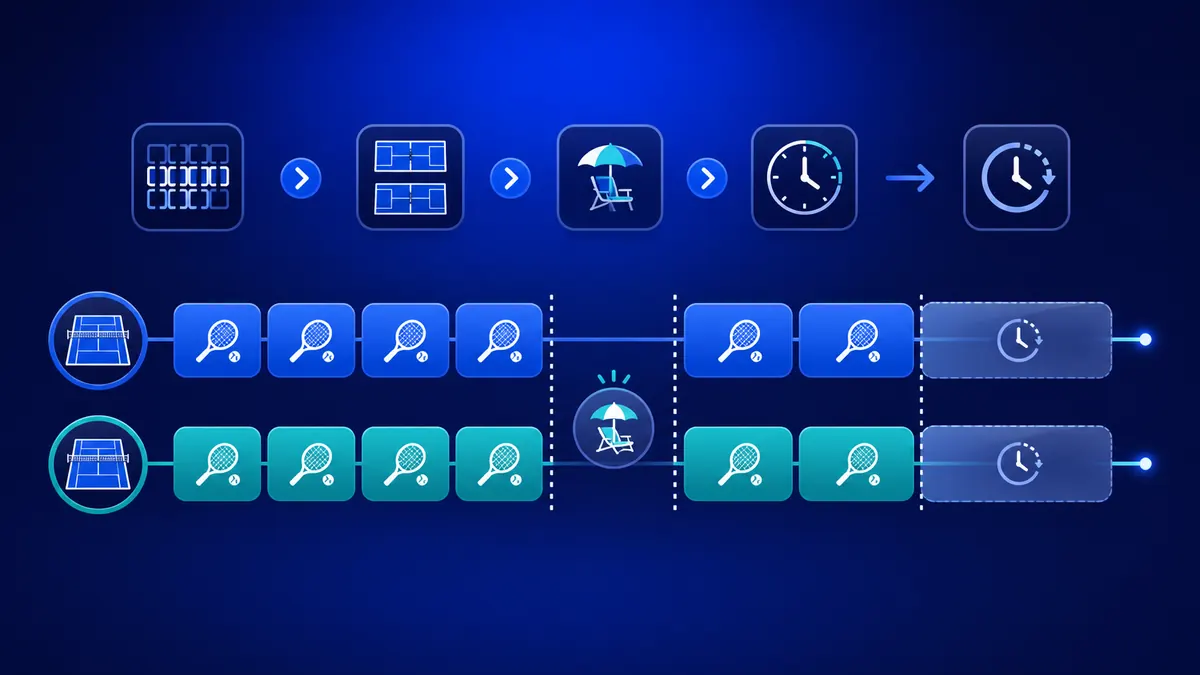
To estimate tournament length, do not simply divide total games by available courts. First define a game slot that includes both play and turnover. Then count how many waves each round needs. Add check-in, breaks, awards and a delay buffer—often 10% to 20%, depending on how predictable the sport and venue are. The working formula is: playing time = the sum of each round’s waves × game-slot length. This method accounts for bracket dependencies, such as a semifinal waiting on a quarterfinal, and for the obvious but frequently missed constraint that one team cannot occupy two courts at once. It also makes the championship less likely to run past the venue’s closing time.
The complete formula
Build the estimate from four blocks:
- Game slot = expected maximum match time + turnover.
- Playing waves = groups of games that can run simultaneously.
- Fixed time = check-in + briefing + breaks + awards + teardown.
- Buffer = time reserved for overtime, injuries, corrections and late starts.
The total is:
event duration = (playing waves × game slot) + fixed time + buffer
For a round-based format, calculate waves separately for every round:
waves in one round = ceiling(games in the round ÷ usable courts)
“Usable courts” may be fewer than the physical spaces in the building. A court without the required net, official, scorekeeper or lighting does not increase real capacity.
Why “games ÷ courts” often underestimates the day
Consider an eight-team bracket: four quarterfinals, two semifinals and one final. There are seven
games. With two courts, ceiling(7 ÷ 2) = 4 happens to produce four slots because the rounds require
2 + 1 + 1 waves.
With four courts, however, basic division gives ceiling(7 ÷ 4) = 2. That is impossible. All four
quarterfinals can run together, but the semifinals must wait, and the final must wait again. Three
slots is the theoretical minimum. More courts cannot remove dependencies between rounds.
Rest rules can add another constraint. If the winner of the last quarterfinal is assigned to the first semifinal immediately, that start may be unfair or violate event rules. A planned rest period can turn three theoretical waves into four workable ones.
Step 1 — Define a realistic game slot
A game slot may include:
- regulation play or a time limit;
- possible overtime;
- permitted warm-up;
- score entry and confirmation;
- teams leaving and entering the court;
- resetting equipment or the playing surface.
If a typical game lasts 22 minutes, a 22-minute slot is not realistic. A 30-minute slot leaves eight minutes to finish, verify the result and turn over the court. For sports with variable game lengths, use a cautious percentile from past events instead of the fastest average you can justify.
The sport’s rules remain the source of truth. Pickleball, ball hockey and cornhole matches do not have the same duration or overtime risk.
The 8-, 10- and 12-team pickleball schedule examples show how those assumptions change a complete event plan.
Step 2 — Count games by round
Single elimination
An eight-team bracket has 4, 2 and 1 games in successive rounds. With two courts:
| Round | Games | Waves | 30-minute slots |
|---|---|---|---|
| Quarterfinals | 4 | 2 | 60 min |
| Semifinals | 2 | 1 | 30 min |
| Final | 1 | 1 | 30 min |
| Playing total | 7 | 4 | 120 min |
Add 15 minutes for check-in, 15 for a captains’ meeting, 20 for awards and 25 as a buffer. A sensible venue booking is now about three hours even though games occupy only two.
Round robin
An eight-team round robin contains 28 games over seven rounds of four games. On two courts, every round needs two waves. With a 30-minute slot:
7 rounds × 2 waves × 30 minutes = 420 minutes
That is seven hours of play before lunch, check-in or a buffer. Four courts reduce each round to one wave, or three and a half hours of play. How Many Games Are in a Round Robin? helps confirm the game and round counts. To move from arithmetic to real assignments, learn how to assign games across courts and time slots.
Swiss system
A 16-team, four-round Swiss event generally creates eight games per round, or 32 games. Four courts need two waves per round. At 25 minutes per slot, play takes about 200 minutes. Leave additional time between rounds to confirm results and create the next pairings.
Swiss therefore gives organizers more control than a full round robin, which would require 15 rounds and 120 games for the same 16 teams. Read the Swiss system guide to choose a suitable number of rounds.
Step 3 — Add the time when nobody is playing
A credible plan includes non-playing work:
| Block | Questions to ask |
|---|---|
| Setup | Are lines, nets, tables, screens and signs already in place? |
| Check-in | Must teams confirm attendance or rosters? |
| Briefing | Do captains understand format, scoring and tiebreakers? |
| Breaks | Does the venue require lunch, resurfacing or maintenance? |
| Results | Who confirms scores before the next round is released? |
| Awards | Do photos, announcements, medals and cleanup need time? |
Some blocks can overlap; others cannot. Do not schedule the captains’ meeting during setup when the same volunteers are responsible for both.
Step 4 — Choose a buffer that matches the risk
A 10% buffer may be enough for timed games, experienced teams and a compact venue. Use 20% or more when match lengths vary, teams are new, all scores flow through one device, or the event spans several areas.
Place some buffer before the most important games. Ten minutes recovered before the semifinals is more valuable than thirty unused minutes after everyone has gone home.
Three ways to shorten the event without improvising
Reduce the game count
Move from a full round robin to a fixed number of rounds, smaller pools or Swiss. Single elimination reduces the count further but also lowers the guaranteed-games floor. Which Tournament Format Should You Choose? walks through that tradeoff.
Increase usable capacity
Another court helps only when it also has the equipment and people needed to operate. Assigning a scorekeeper to each playing area and sharing a score-entry link can reduce the delay caused by moving results back to one central table.
Simplify turnover
Display upcoming games, call teams before the court opens and publish a late-arrival rule. Teams that know where to go often save more time than a complicated last-minute format change.
What Rally calculates — and what it can schedule
Rally generates games, rounds, standings and brackets for the selected competition format. Scores can be entered and shared without manually rebuilding standings. Rally can also turn that structure into an actual timetable: declare your courts in an online Rally tournament — free account, creation wizard — and it assigns each game a start time and a court, keeps a team’s minimum rest between games, and lets you move one game without rebuilding the rest of the day. Use its competition structure — scheduled or not — as an input, then build the venue plan around your own physical constraints.
Validate the estimate before registration opens
A sound estimate is not a promise accurate to the minute. It is a transparent budget that separates playing time, turnover, breaks and risk. Calculate round by round, test a scenario in which games run slightly long and confirm that the championship still fits inside the booking.
Preview the competition structure with Rally’s tournament generator, then copy each round’s game count into your planning grid. Add the result to your tournament planning checklist and communicate a conservative finish time to teams.
Official sources
Consulted September 2, 2026:
- FIVB, Official Volleyball Rules 2025-2028, for volleyball match format and scoring.
- IFAF, 2023 Flag Football Rulebook, for an official example of playing time and overtime. Always replace the examples with your sport’s current rules.
For your sport
Pickleball tournament
Skill-level pools in the morning, finals after lunch.
Volleyball tournament
Captains sign up, the whole gym follows the standings.
Dek hockey tournament
Dozens of games across several rinks.
Cornhole tournament
Doubles, cancellation scoring, several sets of boards.