



Tournament formats
Which Tournament Format Should You Choose?
Compare formats by team count, available time and playing areas, and the games guaranteed to each team.
In this guide
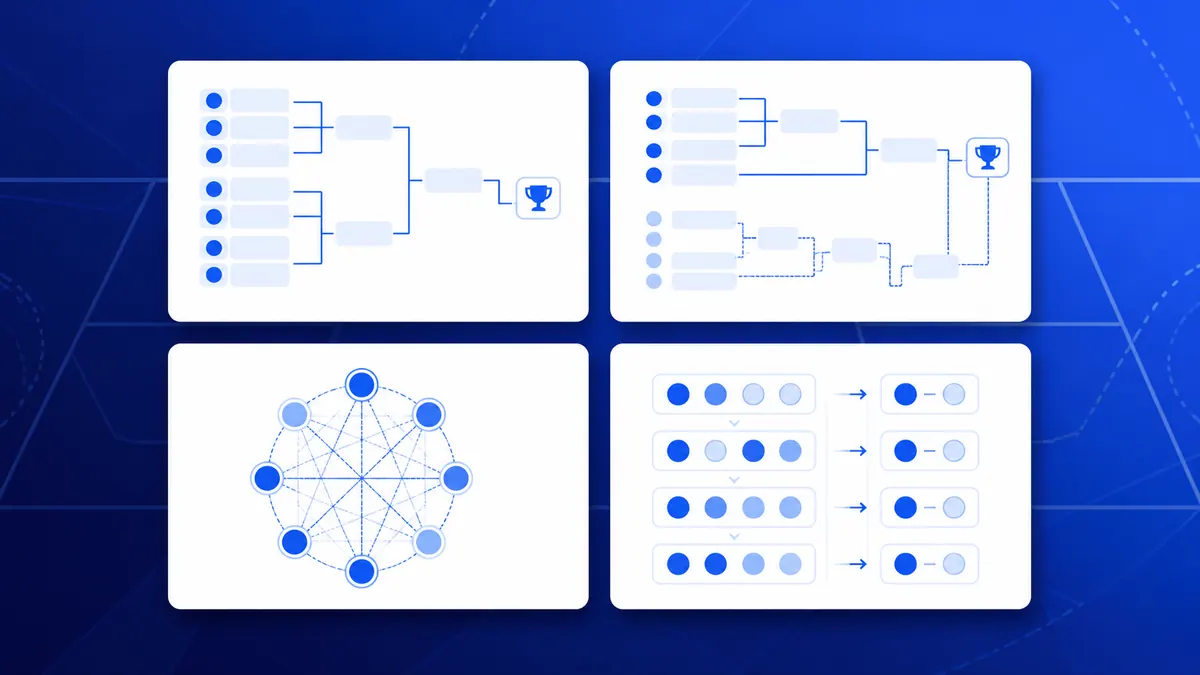
The best tournament format is the one that fits your actual day and delivers the experience you promised. Single elimination is usually the most practical choice when time is tight. Round robin is better when every team needs several guaranteed games. Double elimination gives a team one loss without ending its run. A Swiss tournament lets a large field play a fixed number of rounds without scheduling every possible matchup. Before choosing, write down four constraints: your confirmed team count, the usable competition window, the number of courts or playing areas, and the minimum number of games each team should receive. Those answers matter more than which bracket looks best on paper.
The short answer
| Your top priority | Format to consider first | Why |
|---|---|---|
| Finish in the least time | Single elimination | It crowns a champion in only n - 1 games |
| Guarantee the most games | Round robin | Every team plays every other team in its group |
| Keep one loss from ending a team’s event | Double elimination | A team is normally out after its second loss |
| Give a large field a fixed number of rounds | Swiss system | Teams play opponents with similar records each round |
Treat this table as a starting point. Rules from your sport’s governing body, commitments made during registration, or venue restrictions may lead to a different answer.
Compare the four common formats
Let n be the number of teams.
| Format | Approximate number of games | Minimum per team | Relative length | Best fit when… |
|---|---|---|---|---|
| Single elimination | n - 1 |
1 | Short | venue time is scarce |
| Double elimination | usually 2n - 2, or 2n - 1 with a bracket reset |
2 | Long | a second chance matters more than simplicity |
| Full round robin | n(n - 1) / 2 |
n - 1 |
Very long as n grows |
the group is small and guaranteed games come first |
| Swiss system | about r × n / 2 for r rounds and an even field |
r |
Controllable | the field is large and the round count must stay fixed |
Total game count is not the same as event duration. Two independent games may run at once on two courts, but a semifinal cannot begin until the relevant quarterfinal is complete. Rest time, turnover and round dependencies all matter. How Long Does a Tournament Take? shows the full calculation.
Single elimination: fast and easy to follow
One loss ends a team’s run. An eight-team bracket needs seven games: four quarterfinals, two semifinals and one final. The bracket is easy to display, and players can see the path to the title at a glance.
The tradeoff is substantial: half of the field plays only once. That can feel disappointing when teams paid an entry fee, travelled, or set aside a full day. Consolation games can improve the experience, but they use additional time and should be part of the published format from the start.
Double elimination: a real second chance
A first loss moves a team into the losers bracket; a second loss eliminates it. This reduces the impact of one poor performance and normally gives every team at least two games. It works especially well when the bracket itself is part of the event’s appeal.
Double elimination takes longer and is harder to explain. You also need a clear grand-final rule. In some versions, the team coming from the losers bracket must beat the undefeated finalist twice. That possible bracket-reset game needs room in the venue booking even if it never happens.
Round robin: the fullest experience for a small group
In a full round robin, every team plays every other team. Six teams create 15 games and five games per team. Eight teams already create 28 games and seven per team. The format produces standings based on multiple results, but its game count grows quickly.
The guide How Many Games Are in a Round Robin? includes the formula, round counts and tables by field size. When time is limited, a partial round robin can use a fixed number of rounds, as long as everyone understands that not all opponents will meet.
Swiss system: control the number of rounds
A Swiss event does not schedule every possible pairing. After each round, it matches teams with similar results. A 24-team round robin would require 23 games per team; five Swiss rounds instead give each team five games.
Swiss is useful when no one should be knocked out early but the field is too large for a complete round robin. It does require timely score entry, updated pairings between rounds and a published tiebreaking method. Read Rally’s Swiss system guide before choosing it solely because the match count is lower.
Choose with four questions
1. How many teams will actually be admitted?
Plan around confirmed teams, not only your target capacity. Single elimination can absorb many field sizes through first-round byes. Round robin grows much faster: moving from eight to twelve teams increases the game count from 28 to 66.
If registration is still open, prepare two formats. You might use single elimination up to 16 teams and switch to Swiss above that number. Publish the deadline and explain when the final format will be locked.
2. How much usable time do you have?
Remove setup, check-in, a captains’ meeting, breaks, awards and teardown from the venue rental. What remains is your playing window. Define one game slot as the match itself plus turnover, then add a buffer for delays.
Do not approve a 28-game round robin simply because 28 ÷ 4 courts = 7. Games belong to rounds, and
one team cannot play two matches at the same time. Build the estimate round by round, then check the
round-robin rotation.
3. How many courts, fields, tables or boards are available?
An extra playing area saves time only when another independent game is ready. Four courts are useful for the opening round of an eight-team bracket, but the championship match still uses one. In a round robin, several courts tend to stay useful for longer because each round contains multiple games.
Rally creates the matchups and competition order. It does not automatically assign a start time or a court to every match; the organizer still plans those venue-specific details.
4. What experience did you promise?
“At least three games,” “everyone plays until lunch,” and “one loss will not send you home” are not marketing details. They determine which formats are acceptable. A short competitive event often favours elimination. A community day may prioritize guaranteed play. A large field may need Swiss to keep everyone involved within a fixed number of rounds.
Three practical scenarios
Eight teams, two courts, one short evening
Single elimination needs seven games across three rounds. On two courts, the quarterfinals use two waves, the semifinals one wave and the final one wave: four game slots. If every team needs more than one game, add a clearly defined consolation or use double elimination and accept a longer event.
Twelve teams, four courts, one community day
A 66-game full round robin is rarely practical in a single day. Smaller pools followed by a knockout stage can guarantee several games while preserving a championship final. From Pool Play to a Knockout Bracket explains advancement and cross-pool seeding.
Twenty-four teams, six courts, five rounds available
Swiss fits the constraint naturally: five rounds, about twelve games per round and five games per team. Six courts require two waves for each round. The schedule must also leave time to confirm scores and publish the next pairings.
Mistakes that cause the most trouble
- Picking a format before calculating the usable playing window.
- Promising three games and then running single elimination without consolation.
- Treating total games and required time slots as the same number.
- Forgetting the possible bracket-reset game in double elimination.
- Changing advancement or tiebreaking rules after play begins.
- Claiming software solves court and start-time constraints when it does not.
Choose first, generate second
Your format should satisfy both the event’s physical limits and its promise to the teams. Start with confirmed entries, calculate the real playing window, check available surfaces and set a minimum game guarantee. You should then be able to explain the decision to players and volunteers in one sentence.
Once those inputs are clear, try Rally’s tournament generator. You can preview round robin, single elimination, double elimination and Swiss structures, then manage teams, scores, standings and sharing. Court and start-time assignments remain yours to plan around the venue.
Official sources
Consulted September 2, 2026:
- FIVB, Official Volleyball Rules 2025-2028.
- FIVB, 2025 Beach Volleyball Sport Operations Manual, for official examples combining pool play and elimination brackets.
For your sport

Pickleball tournament
Skill-level pools in the morning, finals after lunch.

Volleyball tournament
Captains sign up, the whole gym follows the standings.

Beer pong tournament
Single or double elimination, no cardboard bracket.

Spikeball (roundnet) tournament
Tight pool, live point differential, finals bracket.

Dek hockey tournament
Dozens of games across several rinks.

Cornhole tournament
Doubles, cancellation scoring, several sets of boards.

Curling tournament
Round robin bonspiel, draws across the sheets.