



Tournament formats
How Many Games Are in a Round Robin Tournament?
Use the formula, round count and full table to decide whether an all-play-all tournament fits your day.
In this guide
Count the games before you reserve the courts
A single round robin gives every team one game against every other team. For n teams, use:
n × (n - 1) ÷ 2
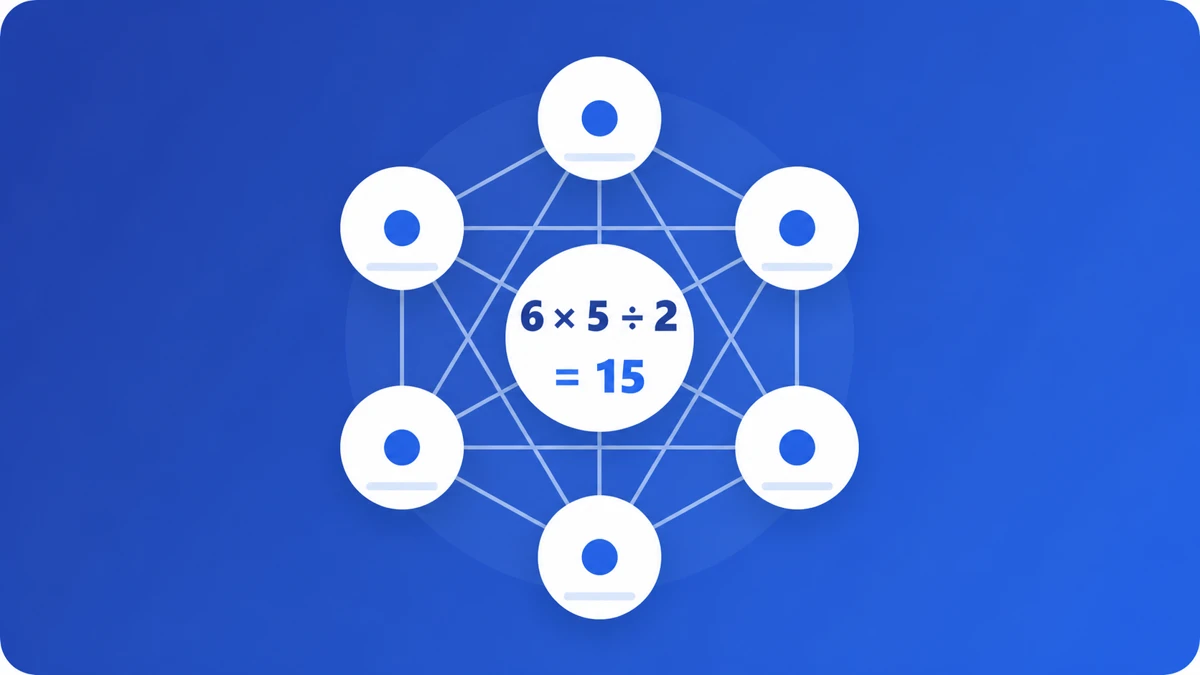
Six teams create 6 × 5 ÷ 2 = 15 games, with five games per team. A home-and-away or double round
robin repeats every pairing, so the same field creates 30 games.
Once the total fits your facility and time window, use the free round robin generator to get every round and matchup. To run the tournament with standings and scores, open the free Rally generator, select Round Robin and add the teams. The organizer still assigns times and courts.
Why dividing by two matters
Each team has n - 1 possible opponents. Multiplying n × (n - 1) counts every pairing from both
directions—Team A versus Team B and Team B versus Team A. Dividing by two keeps each unique pairing
once.
This is the same combination calculation used to count unique pairs. The explanation in OpenStax Contemporary Mathematics provides a useful independent check: 4 teams produce 6 matchups, 8 produce 28 and 20 produce 190.
Planning table: 3 to 32 teams
“Rounds” below means the minimum mathematical rotation when every available team can play at once. It does not promise a court assignment or a start time.
| Teams | Single games | Games per team | Rounds | Double-round games |
|---|---|---|---|---|
| 3 | 3 | 2 | 3 | 6 |
| 4 | 6 | 3 | 3 | 12 |
| 5 | 10 | 4 | 5 | 20 |
| 6 | 15 | 5 | 5 | 30 |
| 7 | 21 | 6 | 7 | 42 |
| 8 | 28 | 7 | 7 | 56 |
| 9 | 36 | 8 | 9 | 72 |
| 10 | 45 | 9 | 9 | 90 |
| 11 | 55 | 10 | 11 | 110 |
| 12 | 66 | 11 | 11 | 132 |
| 13 | 78 | 12 | 13 | 156 |
| 14 | 91 | 13 | 13 | 182 |
| 15 | 105 | 14 | 15 | 210 |
| 16 | 120 | 15 | 15 | 240 |
| 17 | 136 | 16 | 17 | 272 |
| 18 | 153 | 17 | 17 | 306 |
| 19 | 171 | 18 | 19 | 342 |
| 20 | 190 | 19 | 19 | 380 |
| 21 | 210 | 20 | 21 | 420 |
| 22 | 231 | 21 | 21 | 462 |
| 23 | 253 | 22 | 23 | 506 |
| 24 | 276 | 23 | 23 | 552 |
| 25 | 300 | 24 | 25 | 600 |
| 26 | 325 | 25 | 25 | 650 |
| 27 | 351 | 26 | 27 | 702 |
| 28 | 378 | 27 | 27 | 756 |
| 29 | 406 | 28 | 29 | 812 |
| 30 | 435 | 29 | 29 | 870 |
| 31 | 465 | 30 | 31 | 930 |
| 32 | 496 | 31 | 31 | 992 |
Ready-made schedules for the most common fields
Each page below has the full schedule, round by round, with the match count and the rest round for odd fields, ready to print:
- round robin 4 teams and round robin 5 teams;
- round robin 6 teams and 7 team round robin;
- round robin 8 teams and 9 team round robin;
- 10 team round robin and 12 team round robin.
Turn the total into court-hours
A game count becomes useful only when compared with capacity. A rough lower bound is:
event time ≈ ceiling(total games ÷ courts) × average game length
For six teams, 15 games, three courts and 20-minute games, the mathematical minimum is 100 minutes. That is five court waves. A real organizer should then add time for changeovers, warmups, delayed starts, score confirmation and breaks.
The estimate assumes every court stays full. Dependencies between rounds and required rest can make the event longer. Rally’s schedule builder — an opt-in step of an online Rally tournament, turned on once your courts are declared — assigns each game a start time and a court, keeps a team’s minimum rest between two games, and lets you move one game without rebuilding the rest of the day. Until you turn it on, treat the math above as your planning model.
A Saturday pickleball sanity check
Suppose eight pairs sign up for a community event. A full round robin creates 28 games. With four courts, the theoretical rotation has seven waves. At 18 minutes per game, that is 126 minutes before any transition margin. With only two courts, the same competition needs at least 14 waves, or 252 minutes before breaks.
That comparison—not the team count alone—tells you whether the format fits. If the facility rental is three hours, four courts may work with disciplined transitions; two courts probably call for pools or a different format.
Build the rotation differently for even and odd fields
An even number of teams needs n - 1 rounds. Every team plays in every round, and each round contains
n ÷ 2 simultaneous games. Eight teams therefore need seven rounds of four games: 28 total.
An odd number of teams needs n rounds. One team sits out in each round while the other teams play
(n - 1) ÷ 2 games. Seven teams use seven rounds of three games; every team plays six games and has
one idle round.
That idle round is sometimes called a bye, but it is not a win. It is the rotation required to let an odd-sized group complete every unique matchup. A round-based layout similar to this appears in an Alberta Education tournament resource.
Decide whether repeat matchups add real value
A double round robin gives each pair two games, often used as home and away in a season. Every team
plays 2(n - 1) games, and the total is n(n - 1).
For ten teams, the difference is substantial:
- single round robin: 45 total games and 9 per team;
- double round robin: 90 total games and 18 per team.
The return matchup can reduce the effect of one unusual result and balance venue roles. For a one-day recreational tournament, it usually doubles the burden without doubling the available time.
Know when one large group is the wrong design
Once the count is known, follow the checked method to build a conflict-free round-robin schedule.
Round robin growth is quadratic. Adding one team adds a game against every team already entered. Moving from 8 to 16 teams increases the total from 28 to 120, not merely from 28 to 56.
Useful planning thresholds are contextual, but the pattern is consistent:
- up to 6 teams, a complete group is often easy to operate;
- from 7 to 10, game length and court count become decisive;
- beyond 10, a one-day event usually needs short games, many playing areas or a different structure.
You can split the field into pools and send qualifiers to a bracket. You can also use elimination or a Swiss system tournament, where everyone plays a fixed number of rounds without meeting every opponent.
A pickleball tournament may prioritize guaranteed games. A volleyball tournament with limited courts may favor smaller pools. A roundnet event can use short pool play to seed an elimination phase.
Frequently asked questions
How many games are in an 8-team round robin?
There are 8 × 7 ÷ 2 = 28 games. Each team plays seven times across seven rounds of four games.
How many games are in a 10-team round robin?
There are 10 × 9 ÷ 2 = 45 games. Each team plays nine times across nine rounds of five games.
How many games are in a 12-team round robin?
There are 12 × 11 ÷ 2 = 66 games. Each team plays eleven times across eleven rounds of six games.
Can we stop before every team has played everyone?
Yes. Rally can limit the number of rounds, but the result is no longer a complete round robin and teams may face different strengths of schedule. Publish the round limit and tiebreak rules before play.
Calculate, test the capacity, then generate
The formula is the early warning system. If the total fits the court-hours you actually own, choose Round Robin in Rally and let the generator build the pairings and standings. If it does not, change the structure before participants arrive.
For elimination formats, seeding and bye placement, continue with how to make a tournament bracket for free.
If you are choosing a tool after planning the field, compare the best free tournament software for schedules, registration and live scores.
For your sport

Pickleball tournament
Skill-level pools in the morning, finals after lunch.
Volleyball tournament
Captains sign up, the whole gym follows the standings.

Spikeball (roundnet) tournament
Tight pool, live point differential, finals bracket.

Dek hockey tournament
Dozens of games across several rinks.

Cornhole tournament
Doubles, cancellation scoring, several sets of boards.