



Tournament operations
How to Make a Tournament Bracket for Free
From format selection to byes, make the important decisions before the first game begins.
In this guide
Build the bracket after you settle five decisions
You can make a tournament bracket for free in Rally with no account. The clicking takes a minute; the decisions that keep the tournament fair take a little longer. Before opening the bracket generator, confirm the field, format, starting order, bye policy and official source for results.
A bracket controls progression: it shows opponents and where each winner goes. It is not a facility schedule. Start times, courts, rest windows and volunteer assignments still need a separate plan.
Match the format to your event promise
Players care about how many chances they get and how long they will be on site. Pick the format that can honor that promise with the space and time available.
| What you promised | Format to consider | Cost of that choice |
|---|---|---|
| A fast playoff | Single elimination | One loss can end the day |
| At least two chances | Double elimination | More games and a denser bracket |
| A game against every team | Round robin | Game count grows quickly |
| A fixed number of rounds for a large field | Swiss system | Later opponents depend on prior results |
Single elimination always needs n - 1 games for n teams. Double elimination adds a losers
bracket and requires two losses to eliminate a team. Round robin ranks the full set of head-to-head
games; check the round robin game-count table before promising
it. Swiss play pairs teams with similar records without scheduling every possible matchup; the
Swiss system guide explains the flow, and Rally can open it in the
Swiss generator.
An eight-team Saturday event might fit any of these formats. Two rented courts for two hours point toward elimination. An all-day gym and a guarantee of several games may justify pools or round robin. The sport name alone cannot make that decision.
Freeze the field before you draw
Remove duplicates, confirm spelling and settle withdrawals before play begins. Adding one late team can change byes, seed placement and every connected matchup. Rally therefore locks the local field and format after the tournament starts.
Decide what each bracket line represents. A pair can be one team in a pickleball tournament or cornhole event. A volleyball tournament usually uses one team name for a full roster. Keep that display name stable even if the shared tournament stores more participant detail.
Choose a starting order people can understand
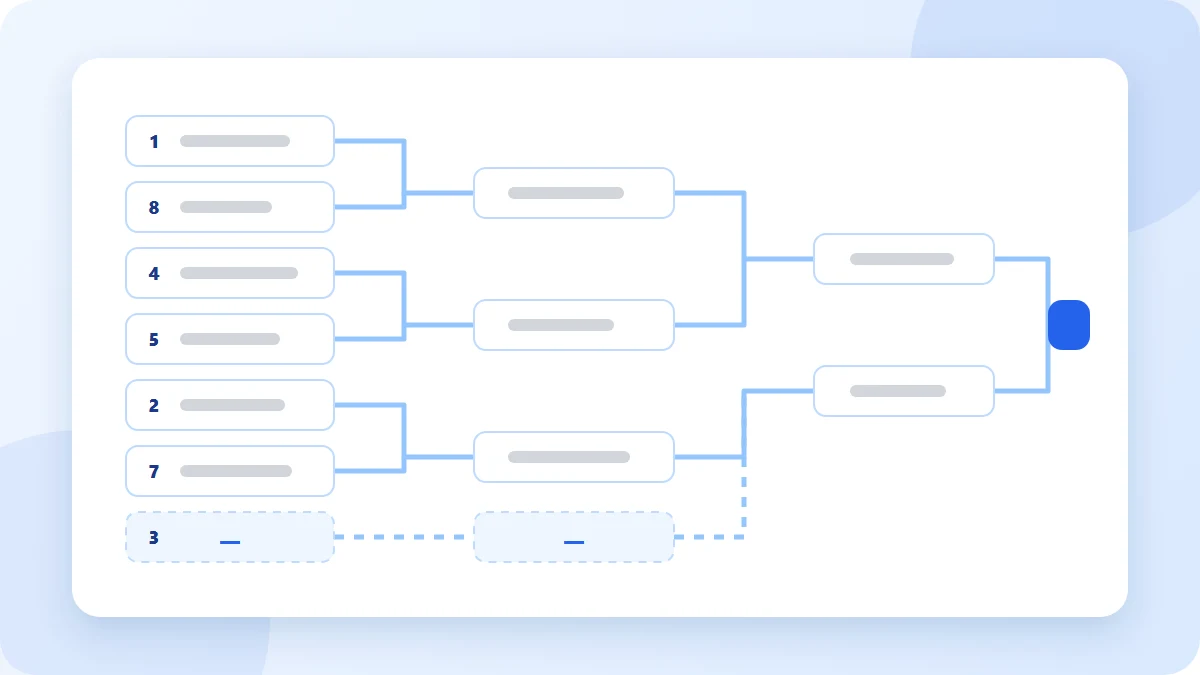
Seeding is useful when prior results or qualification rules identify stronger teams. A familiar eight-team pattern places 1 versus 8, 2 versus 7 and so on, keeping the top seeds apart early.
A random draw is often the better social contract for a neighborhood fundraiser or first-year rec league. Whichever method you use, announce it before the bracket appears. A transparent rule is far easier to defend after an upset than a seed list nobody saw.
Sanctioned events should follow their governing body rather than a generic blog rule. The USTA’s 2026 Friend at Court, for example, documents formal tennis procedures for seeds and byes. Those procedures are evidence of how precise a rulebook can be, not a universal policy for every sport.
Use byes to complete the shape, not to invent games
Single- and double-elimination brackets are cleanest at powers of two: 4, 8, 16 or 32 lines. A field between those sizes needs byes. The calculation is:
- find the next power of two;
- subtract the actual number of teams;
- assign that many byes according to the announced policy.
| Teams | Full bracket size | Byes | Opening games |
|---|---|---|---|
| 6 | 8 | 2 | 2 |
| 10 | 16 | 6 | 2 |
| 12 | 16 | 4 | 4 |
| 14 | 16 | 2 | 6 |
Walk through a 10-team community playoff
Ten teams fit into a 16-line bracket with 16 - 10 = 6 byes. Four teams play two opening games; the
two winners then join the six teams that advanced by bye to form the round of eight.
The tournament still requires nine games because single elimination with ten teams always needs
10 - 1. A bye changes when a team first plays, not the number of opponents that ultimately have to
be eliminated. If the rules award byes to the six highest seeds, teams 7 through 10 play the opening
games. If the event uses a random draw, publish how the bye positions are drawn.
Rally builds the required empty positions from the team count. You still own the policy that decides which teams receive them.
Run this launch check at the control table
Once the decisions are settled:
- enter the confirmed team list, one team per line;
- select single elimination, double elimination, round robin or Swiss;
- seed or shuffle according to the rule you announced;
- verify the number of byes and every opening matchup;
- start only after check-in closes.
The public Rally generator supports 2 to 32 teams, and double elimination requires at least 3. It can run the tournament in the browser, advance teams after score entry, resume on the same device and print a wall copy. A saved shared tournament can contain up to 64 teams, although 64-team round robin would be operationally unrealistic for most events.
During play, pick one official score source. A printed bracket is a useful overview and backup, but handwritten changes should not quietly diverge from the scores used to advance teams on screen.
Move from local to shared only when the workflow needs it
One device is enough for a backyard event or a staffed check-in desk. Create a free organizer account when the competition needs to span several phones:
- a registration invitation accepts participant requests without participant accounts;
- a scorekeeper link delegates result entry without exposing organizer settings;
- a spectator link publishes a read-only live view.
The product overview, Meet Rally: from brackets to live scores, shows how those roles fit together. Sharing does not change the tournament rules; it changes who can perform or observe each job.
Avoid the failures that force a redraw
Do not confuse progression with scheduling. The bracket says who can play next. It does not know that Court 2 is unavailable or that teams require a rest period.
Do not reopen the field after the first score. Handle a later withdrawal with the forfeit rule announced for the event instead of rebuilding completed matchups.
Do not choose round robin by feel. Twelve teams create 66 games. Count games, courts and average duration before calling that a one-day format.
Do not improvise tiebreakers at the end. For pools, publish the order—wins, points, differential, points scored or head-to-head—as required by your sport.
Frequently asked questions
Can I make and print a bracket without signing up?
Yes. Rally’s public generator can run and print a local tournament without an account. The saved state remains in that browser on that device.
How many byes do 10 teams need?
Six. The next full bracket has 16 lines, so 16 - 10 = 6. The other four teams play two opening
games.
Does a tournament bracket include game times and courts?
No. A bracket defines opponents and advancement. Build the day-of schedule separately around court capacity, expected game length, breaks and dependencies between rounds.
Generate only after the first round looks right
The strongest bracket is not the most decorative one. It is the one whose field, format, seed rule and byes can be explained before the opening whistle. Enter the real names in Rally, review every first-round matchup, then let the bracket carry the results toward the champion.
For your sport

Pickleball tournament
Skill-level pools in the morning, finals after lunch.
Volleyball tournament
Captains sign up, the whole gym follows the standings.

Beer pong tournament
Single or double elimination, no cardboard bracket.

Spikeball (roundnet) tournament
Tight pool, live point differential, finals bracket.

Dek hockey tournament
Dozens of games across several rinks.

Cornhole tournament
Doubles, cancellation scoring, several sets of boards.