



Tournament formats
Tournament Tiebreakers Explained
Set a transparent order for two-team ties, mini-tables, point differential and forfeits before play begins.
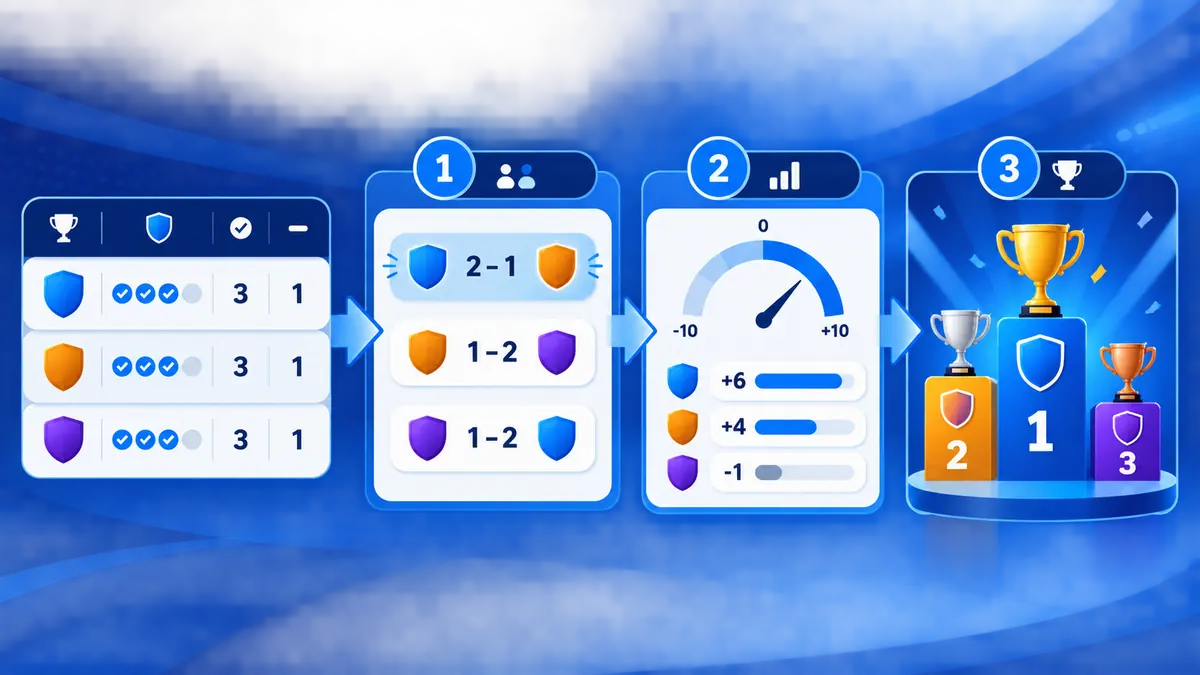
In this guide
The best tournament tiebreaker is one teams can read before game one and organizers can apply without improvising. When exactly two tied teams played each other, head-to-head is usually the most intuitive first criterion. For three or more teams, use a mini-table containing only games among the tied teams, then a capped point differential. Points scored can follow. Your policy should also cover forfeits, abandoned games and groups in which teams played different numbers of games. The official rules for your sport always take precedence over this general framework. A worked example in the published rules also makes the sequence easier to trust.
In Rally: the main criterion, points scale and tiebreak order are configured directly in the tournament, with no workaround needed. See configurable tiebreakers on the features page.
Publish the order before you know who will be tied
Tiebreakers affect behaviour. Point differential can encourage a team to keep scoring in a game that is already decided. Head-to-head rewards a direct result but may not resolve a three-way tie. A random draw is neutral, yet frustrating when competition results could still separate the teams.
Choosing after pool play therefore creates a conflict even when the organizer acts honestly. Include the complete order in the registration rules, repeat it at the captains’ meeting and keep scores visible during the event.
Compare common tiebreaking criteria
| Criterion | Advantage | Limitation |
|---|---|---|
| Head-to-head | Simple and tied to the direct matchup | Fails when teams did not meet or form a three-team loop |
| Mini-table | Isolates games among tied teams | May rely on a very small sample |
| Point differential | Uses performance across several games | Can encourage running up the score |
| Points scored | Easy to calculate | May reward pace rather than game control |
| Points allowed | Rewards defence | Depends heavily on sport and style |
| Play-in game | Settles the issue on the field | Needs time and a playing area |
| Random draw | Resolves any remaining tie | Does not reflect performance |
There is no universal sequence. Soccer, volleyball, pickleball and ball hockey organizations may all use different rules. Adopt the governing body’s policy whenever it applies to your event.
Case 1 — A two-team tie
The Falcons and Vipers both finish 3–1. They played each other, and the Falcons won. If your rules put head-to-head first for a two-team tie, the Falcons rank higher.
The policy still needs to answer two questions:
- Does head-to-head apply only when exactly two teams are tied?
- If another criterion separates one team from a three-way tie, do the remaining two restart at head-to-head or continue to the next criterion?
Both approaches exist. Pick one and state it. For example: “Whenever one team is placed, the remaining tied teams restart at the first criterion.”
Case 2 — A circular three-team tie
Suppose three teams finish 2–1 and each beat one of the others:
- Falcons beat Vipers 12–10;
- Vipers beat Bears 15–11;
- Bears beat Falcons 14–9.
Head-to-head alone creates a loop. Build a mini-table using only those three games:
| Team | For | Against | Differential |
|---|---|---|---|
| Vipers | 25 | 23 | +2 |
| Bears | 25 | 24 | +1 |
| Falcons | 21 | 24 | -3 |
The Vipers rank first, followed by the Bears and Falcons. The calculation is comparable because every tied team played the same number of mini-table games.
If two teams remain exactly level, your policy should say whether they restart with head-to-head or move to the next item.
Why point differential should be capped
Without a cap, a 40–2 win may count far more than a 12–10 win even though each is one victory in the standings. That gives teams an incentive to widen a mismatch at the expense of a weaker opponent’s experience.
A differential cap reduces the incentive. With a cap of 10, a 25–3 win adds +10 to the tiebreaker, not +22. The corresponding loss contributes -10. The right cap depends on the sport: five may be large in a low-scoring game and meaningless in a sport regularly played into double digits.
Apply the same logic to forfeits. Recording a 1–0 administrative score in a high-scoring sport might hurt the winner; recording 50–0 might grant an unfair bonus. Publish the forfeit score and its effect on differential before the event.
A general order you can adapt
For a recreational round robin in which every team plays the same number of games, this is a defensible starting point:
- standings points or winning percentage;
- head-to-head when exactly two teams are tied;
- record in a mini-table among all tied teams;
- capped differential in the mini-table, then across all games if needed;
- capped points scored or points scored per game;
- fewest points allowed;
- a play-in game when time permits, otherwise a documented random draw.
This is not a Rally rule or a governing-body standard. It is a template for approval by the event’s sports lead. When teams played different numbers of games, use percentages and per-game averages instead of raw totals.
Forfeits and missing results
Rare cases often cause the longest disputes. Your policy should define:
- the score assigned to a forfeit;
- whether forfeits affect differential and points scored;
- what happens when a team withdraws;
- how an abandoned game is recorded;
- what happens when a result has not been confirmed;
- who has final decision authority.
Put those choices into a delay and no-show policy published before the first game.
If a team withdraws after two games, deleting both results can change standings already shown to players. Keeping them may leave teams with unequal schedules. There is no perfect universal answer; follow the published rule consistently.
Do not mix round-robin and Swiss tiebreakers blindly
A Swiss event may use strength of schedule before point differential. That makes sense because teams do not all face the same opponents. Copying the criterion into a small, complete round robin may add complexity without improving fairness.
Rally has format-specific logic for its Swiss tournaments. Confirm the criteria actually used by the selected format rather than publishing a generic sequence that contradicts the standings teams see.
Make the result verifiable on tournament day
Display standings, results and the rule in one place. When a tie occurs, name the criterion and show the relevant values: “All three teams are 2–1; the mini-table differentials are +2, +1 and -3.” One line of explanation is better than a silent change in position.
Before pool play starts, test the policy with a two-team tie, a circular three-way tie and a forfeit. Add that check to the tournament planning checklist. Rally can centralize scores and standings; the published sports policy remains the organizer’s responsibility.
If you are choosing the tool that will publish those rules, compare the best free tournament software for standings, scheduling and score entry.
Official sources
Consulted September 2, 2026:
- FIVB, 2025 Event Regulations, articles 8.3 to 8.5 on ties and rankings.
- IFAF, 2023 Flag Football Rulebook, for an official tiebreak sequence beginning with head-to-head results.
For your sport

Volleyball tournament
Captains sign up, the whole gym follows the standings.

Dek hockey tournament
Dozens of games across several rinks.