



Tournament formats
From Pool Play to a Knockout Bracket
Set qualifiers, crossover rules and seeding before turning pool standings into a fair knockout bracket.
In this guide
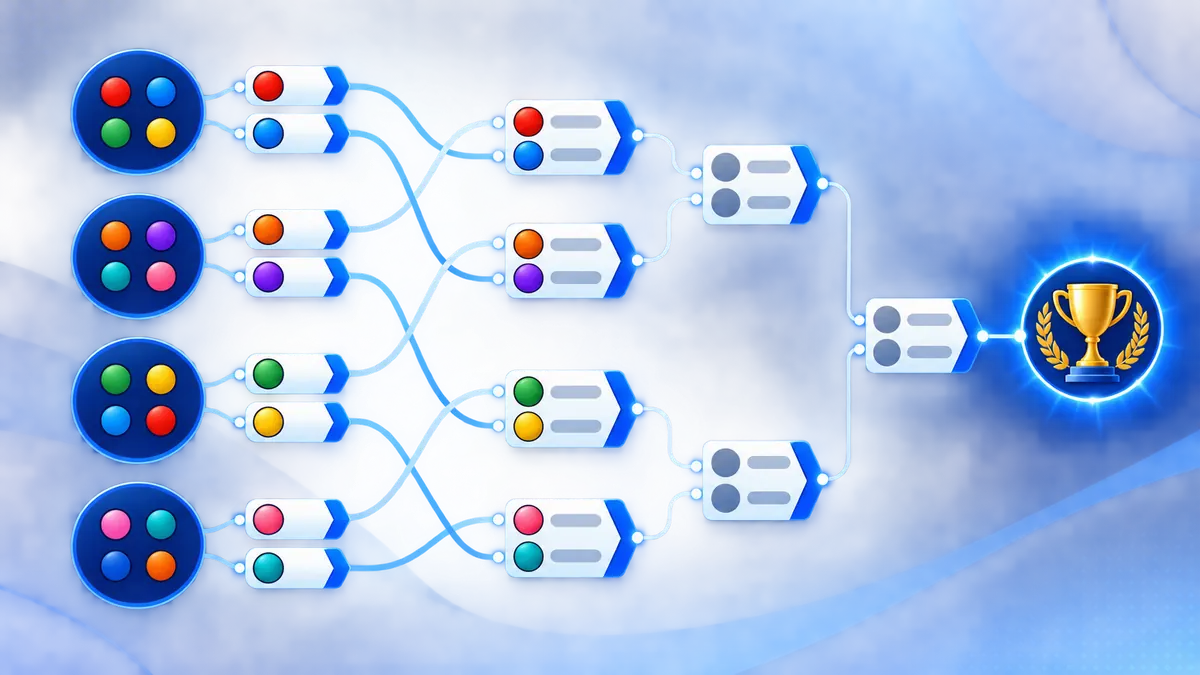
To move from pool play into a knockout bracket, first decide how much of the field should remain after the ranking stage. Advancing half the teams is a useful default: pool games are meaningful, but every team receives guaranteed play. With two pools, the common crossover is A1 versus B2 and B1 versus A2. With four pools, build an eight-team bracket that keeps the two qualifiers from each pool apart until the final whenever possible. Publish the number of advancing teams, the exact tiebreaking order and the treatment of forfeits before the first game. The bracket should apply a known rule, not a decision made after organizers see who qualified.
In Rally: the “Pool play into a final bracket” format handles several pools, qualification and crossover automatically, feeding the final bracket directly from the standings. See this format on the features page.
Step 1 — Decide what pool play is meant to accomplish
Pool play can serve two different goals:
- guarantee games before a selective playoff;
- rank the field so the final bracket starts with more balanced seeds.
At a community event, advancing 50% to 75% of the field gives more participants a playoff experience. At a shorter competitive tournament, sending only the pool winners forward saves time and makes each pool result more consequential.
Write the goal as a promise: “Every team plays three pool games, and the top two in each group advance.” You can then test the promise against available time, courts and the overall game count.
Step 2 — Choose a practical playoff size
Knockout brackets are simplest with 2, 4, 8 or 16 qualifiers. Other numbers work through byes, but some seeds then enter later than others.
| Pool-stage field | Pool setup | Straightforward advancement | Playoff size |
|---|---|---|---|
| 8 | 2 pools of 4 | top 2 per pool | 4 teams |
| 10 | 2 pools of 5 | top 2 per pool | 4 teams |
| 12 | 3 pools of 4 | top 2 plus 2 wild cards | 8 teams |
| 16 | 4 pools of 4 | top 2 per pool | 8 teams |
| 20 | 4 pools of 5 | top 2 per pool | 8 teams |
The 12-team model needs an extra rule. Comparing third-place teams across three pools is reasonable when all pools have the same size, play the same number of games and use identical scoring rules. Raw win or point totals are not directly comparable when those conditions differ.
Step 3 — Count the games before advertising the format
Two pools of four produce six games each, for twelve pool games. Two semifinals and a championship bring the total to fifteen. A third-place game makes sixteen.
2 pools × [4 × 3 ÷ 2] = 12 pool games
2 semifinals + 1 final = 3 knockout games
total = 15 games, or 16 with a bronze-medal game
Two pools of five produce twenty games before the playoff. Four pools of four create twenty-four, then an eight-team bracket adds seven. That event contains 31 games.
More courts may shorten the day, but they do not remove round dependencies. Use the tournament duration method to convert these totals into workable playing waves.
Model 1 — Two pools, four qualifiers
The standard crossover looks like this:
| Semifinal | Team 1 | Team 2 |
|---|---|---|
| 1 | A1 | B2 |
| 2 | B1 | A2 |
The winners meet in the championship. This setup rewards first place with the other pool’s runner-up and prevents an immediate rematch against a team from the same group.
If you include a third-place game, the semifinal losers play it. Otherwise, state whether both teams finish third or whether another published criterion will order them.
Model 2 — Four pools, eight qualifiers
With the top two from pools A, B, C and D, one workable placement is:
| Quarterfinal | Matchup |
|---|---|
| Q1 | A1 vs B2 |
| Q2 | C1 vs D2 |
| Q3 | B1 vs A2 |
| Q4 | D1 vs C2 |
Match the Q1 winner against the Q2 winner, and Q3 against Q4. A1 and A2—and the two qualifiers from every other pool—can now meet only in the final. The design limits early rematches without moving a team away from the position it earned.
Draw the pool pairings before the event if needed: A with B and C with D, for example. Do not redesign the crossover once the qualifiers are known. Even a well-intentioned adjustment can look like the organizer selected preferred opponents.
Model 3 — Three pools and wild cards
To move from three pools of four into an eight-team bracket, advance each pool’s top two and the two best third-place teams. The difficult part is comparing those wild cards fairly.
Use only comparable measures:
- winning percentage;
- capped point differential per game;
- points scored per game;
- a documented random draw if the tie remains.
A differential cap—such as counting no more than +10 from one game—reduces the incentive to run up the score against a weaker opponent. The appropriate cap depends on the sport. Publish it with the full tournament tiebreaking rules.
Once all eight teams are selected, place the three pool winners first, followed by runners-up and wild cards. Avoid same-pool quarterfinals whenever possible. If every constraint cannot be satisfied, publish the priority order: earned seed, rematch avoidance, then random draw.
What if the pools have different sizes?
A five-team pool gives each team four games; a four-team pool gives each team three. Total wins, points scored and raw differential will therefore favour the group with more games.
The cleaner options are:
- balance pool sizes before play begins;
- compare percentages or per-game averages;
- for cross-pool comparison only, remove the result against the last-place team in the larger pool if that rule was announced beforehand;
- schedule a play-in game when time allows.
Never invent the method after the last pool game. A less-than-perfect rule announced in advance is easier to accept than a custom rule created after everyone knows which teams benefit.
Tiebreakers to publish before game one
Every pool needs to know:
- the standings points system;
- the order used for a two-team tie;
- the method used for a tie involving three or more teams;
- the recorded score for a forfeit;
- how an abandoned game is handled;
- when standings become official.
Head-to-head is intuitive when exactly two tied teams played each other. It can form a loop in a three-team tie, with each team having beaten another. A mini-table followed by capped differential is often easier to apply. The official rules for the sport always take precedence over this generic framework.
Prepare the handoff before pools end
Create the empty playoff bracket with A1, A2, B1 and B2 placeholders before the last pool games. Name the person responsible for confirming standings. Give teams a short window to report a score error, then lock the seeds before announcing the quarterfinals or semifinals.
Rally can run a round robin with standings and a finals stage when the selected tournament settings support that flow. Multiple separate pools may still require an organizer-managed setup depending on the product capabilities available for your event. Do not promise automatic pool assignment, court allocation or start-time scheduling without testing the actual workflow first.
A published rule beats an improvised bracket
A sound transition from pool play to elimination requires three public decisions: who advances, how ties are broken and where each finishing position enters the bracket. Test those rules with both a tie scenario and an uneven number of entries before registration opens.
For a complete sport-specific example, use the pickleball schedule with pools and playoffs.
When the policy is ready, use Rally’s tournament generator to preview the competition structure that fits your format. Keep rules, standings and the playoff bracket in one shared source so players, scorekeepers and spectators all see the same answer.
Official sources
Consulted September 2, 2026:
- FIVB, 2025 Event Regulations, including combined rankings after pool play.
- FIVB, 2025 Beach Volleyball Sport Operations Manual, for an official pool-to-elimination competition example.
For your sport
Pickleball tournament
Skill-level pools in the morning, finals after lunch.
Volleyball tournament
Captains sign up, the whole gym follows the standings.

Spikeball (roundnet) tournament
Tight pool, live point differential, finals bracket.