



Tournament operations
How to Run a Cornhole Tournament
A checked three-hour plan for rotating sixteen teams across four sets of cornhole boards.
In this guide
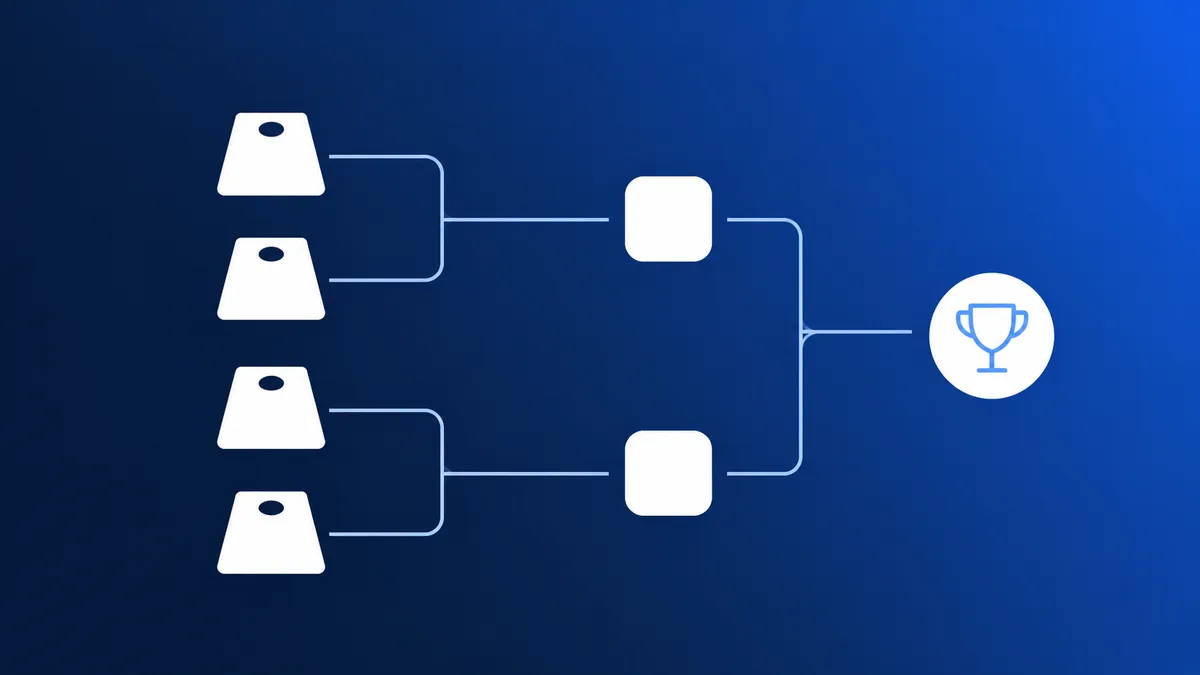
To run a cornhole tournament efficiently, count sets of two boards, not individual boards, and choose a format that fits the booking. With 16 teams, 4 board sets and 3 hours, a workable model is four pools of four, each pool winner advancing to the semifinals, a 20-minute buffer, then the final. Using locally capped 20-minute slots, the 24 pool games, two semifinals and final occupy exactly 180 minutes.
Set the rules before choosing the format
Choose a governing ruleset first. ACO and ACL rules overlap in places, but they are separate systems. Under ACO Season 19, Traditional 21 is won at 21 points or more at the end of a frame, using cancellation scoring: a bag on the board scores one and a bag in the hole scores three.
A board set or court contains the two boards needed for one game: 4 board sets = 8 physical boards = 4 simultaneous games. Do not advertise “four boards” when the setup actually requires eight physical boards.
Publish these decisions before registration:
- the ACO, ACL or local rules being used;
- format and guaranteed-game count;
- any time cap and how an unfinished frame is handled;
- the administrative score for a forfeit;
- tiebreakers and number of qualifiers.
Which Tournament Format Should You Choose? compares pools, single elimination and double elimination.
Calculate the evening’s capacity
Raw capacity is straightforward:
4 board sets × 9 twenty-minute slots = 36 game positions
Thirty-six positions do not mean any bracket will fit. Semifinals must wait for pool play, and the final must wait for the semifinals. This scenario uses 24 positions for pools, 2 for semifinals and 1 for the final. Empty positions cannot remove those dependencies.
A full 16-team round robin requires 120 games and is impossible in three hours. Four pools of four
reduce preliminary play to 4 × 6 = 24 games.
Checked four-set timeline
| Slot | Set 1 | Set 2 | Set 3 | Set 4 |
|---|---|---|---|---|
| 1 | A1–A4 | B1–B4 | C1–C4 | D1–D4 |
| 2 | A2–A3 | B2–B3 | C2–C3 | D2–D3 |
| 3 | A1–A3 | B1–B3 | C1–C3 | D1–D3 |
| 4 | A4–A2 | B4–B2 | C4–C2 | D4–D2 |
| 5 | A1–A2 | B1–B2 | C1–C2 | D1–D2 |
| 6 | A3–A4 | B3–B4 | C3–C4 | D3–D4 |
| 7 | 1A–1B | 1C–1D | Open | Open |
| 8 | Buffer | Buffer | Final setup | Open |
| 9 | Final | Open | Open | Open |
With a 6:00 p.m. start, pools end at 8:00, semifinals run to 8:20, the buffer lasts until 8:40 and the final ends theoretically at 9:00.
All four sets are occupied through the first six slots. The grid therefore does not guarantee a full slot of rest between every pool game. If that rest is mandatory, extend the event, shorten the local slot assumption or guarantee fewer games. ACO and ACL rules do not promise that a real game will end within 20 minutes; the cap is an organizer’s planning choice.
Move teams and scores cleanly
Give every board set a visible number. Display both the current game and the on-deck game, and ask on-deck teams to remain nearby. One central operator should confirm results before standings are calculated.
Use a score sheet for every game with pool, board set, teams, score and signatures. If reports conflict, the signed copy and published correction policy should determine the next step.
After six slots, rank each pool with the announced criteria. Only the pool winners advance here;
cross 1A–1B and 1C–1D. A different crossover can work, but do not change it after seeing results.
What Rally manages for a cornhole tournament
Rally can create the four pools, record scores, produce standings and generate the playoff. Game times, board assignments and an automatic court queue remain on the public roadmap. Use Rally as the source for games and results, and this grid as the physical venue plan.
Create the cornhole tournament in Rally, then publish one official rotation. If a game exceeds its slot, spend the buffer instead of silently shifting every later start.
Practical questions when you run a cornhole tournament
How many boards are actually required? Four simultaneous games need four complete sets, or eight physical boards. Add bags, foul lines, safety clearance and someone able to confirm scores. A pair of boards without usable surrounding space does not increase capacity.
Can two teams qualify from each pool? Yes, but an eight-team playoff adds four quarterfinals and at least one more dependent slot. The event no longer fits the same 180-minute window with a 20-minute buffer. Extend the booking or reduce preliminary play.
Should the event use ACO or ACL rules? Select one primary ruleset and name it in participant information. Do not borrow a timing rule from ACL and a scoring rule from ACO without labeling both as local modifications.
How can the final be protected from delays? Keep Slot 8 as a real buffer rather than filling it with an exhibition game. If unused, finalists receive a break; if consumed, publish the revised final time immediately.
Assign roles across the nine slots
One person directs the event and decides disputes. A second calls teams and watches the rotation. Each board set has a scorekeeper, or the teams clearly name who confirms the sheet. Another operator enters results and retains the originals.
Thirty minutes before play, inspect all eight boards, bags, court numbers and foul lines. Ten minutes before each wave, display the on-deck teams. As soon as one game ends, its scorekeeper returns the result rather than waiting for the other three.
After Slot 6, lock pool entry and check the standings twice. Announce both semifinals together. During the buffer, prepare the final court and publish the confirmed start time.
If one board set becomes unusable
With three sets, 24 pool games require at least eight slots instead of six. Add the semifinals and final, and the minimum becomes ten slots, or 200 minutes at 20 minutes per game, with no buffer. The three-hour scenario no longer fits.
Do not silently compress the games. Repair or replace the equipment, extend the booking or reduce the format under the published policy. Then communicate a revised final time.
Official sources
Accessed September 2, 2026:
- American Cornhole Organization, ACO Official Rules, Season 19, for Traditional 21 and cancellation scoring.
- American Cornhole League, Rules and Regulations, updated October 24, 2025, for its court definition and separate competition rules.
For your sport

Cornhole tournament
Doubles, cancellation scoring, several sets of boards.