



Tool comparisons
5 Myths About Free Bracket Makers
Five common myths, each tested against verifiable facts, plus what remains a genuine limitation.
In this guide
“Free” and “bracket generator” carry a reputation for limited tools: no real tiebreakers, no serious registration, no scheduling, no online visibility, no league support. Five myths, each tested against verifiable facts, plus what’s genuinely still a limitation worth knowing.
Myth 1: “Free means no tiebreakers”
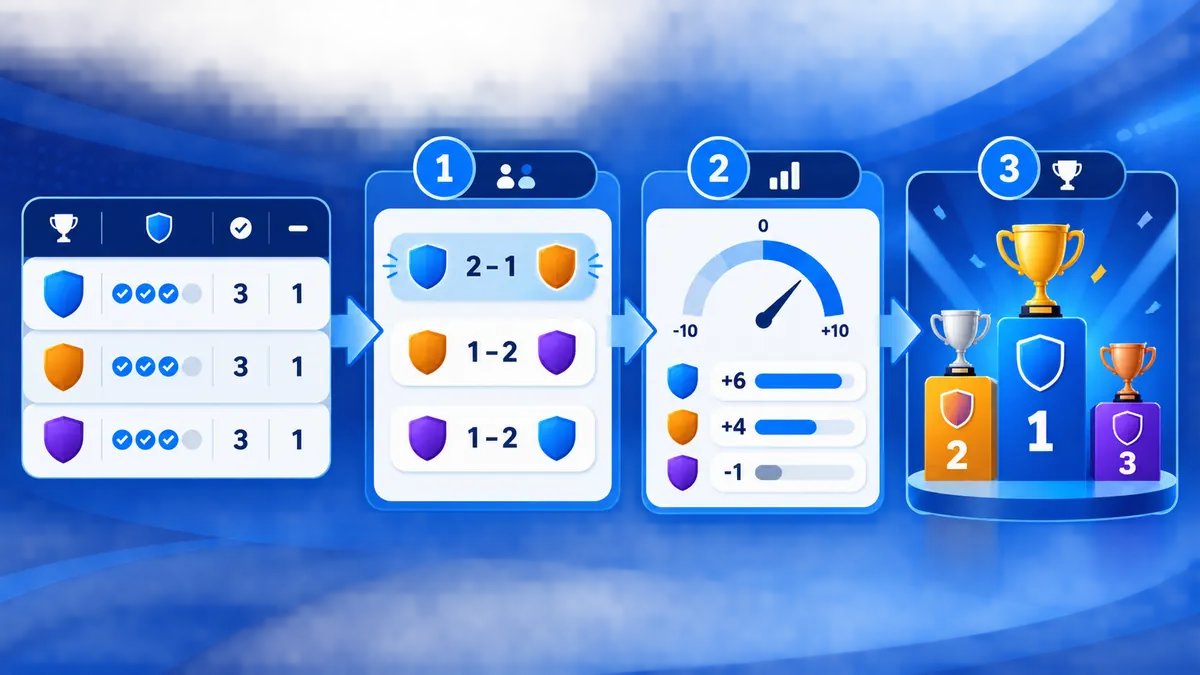
False for several tools. Challonge offers up to three configurable tiebreaker criteria even on its free 0 $ plan (unlimited tournaments, with ads). Rally also lets you pick a main criterion, a points scale and a full tiebreak order (differential, points for, points against, head-to-head, wins) without any of it being locked behind a paid tier. What actually varies between tools isn’t whether they’re free, but whether tiebreakers are configurable or fixed: Common Ninja Bracket Maker, for instance, resolves a tie with a random draw, with no setting to change. See Rally’s configurable tiebreakers · Tournament tiebreakers explained.
Myth 2: “No account means no real registration”
False. Not requiring an account from players doesn’t rule out structured registration: an invite link, team roster, organizer approval and capacity enforced automatically. JustTourney lets players join an informal match with no account while still handling a direct payment to the organizer. Rally applies the same logic to its tournaments: captains and players register through a link, no account needed, with approval and capacity. What Rally does not have, though, is entry-fee payment inside the tool itself — a real limitation, not a myth. Tournament registration without accounts.
Myth 3: “A bracket isn’t indexable on Google”
False if the tournament is published to a public directory. A private bracket, generated on the fly with no stable URL, indeed has nothing for a search engine to index. But a tournament published with a permanent public page can show up in search results. Rally’s public tournament directory lists the tournaments organizers choose to publish, each with its own dedicated page — visibility a bracket without a stable page simply doesn’t get. Public tournament directory, on the features page.
Myth 4: “Bracket generator means no scheduling”
True for some tools, false for others. A simple bracket widget, like Common Ninja’s, shows an optional date field per game, with no engine to place matches across courts or time slots. Score7 and Rally, on the other hand, generate a full schedule: Score7 with auto-scheduling that assigns time slots, courts and referees; Rally additionally accounting for minimum rest between a team’s own games and each court’s specific availability. Tournify sits somewhere in between: it documents field planning for physical tournaments, though the exact detail (rest between games, per-court availability) isn’t publicly confirmed. The phrase “bracket generator” guarantees nothing about scheduling — check the tool, not the category. Rally’s multi-court scheduling · Conflict-free round-robin scheduling.
Myth 5: “A tournament tool doesn’t do leagues”
False, but unevenly so across tools. Several tools built for one-off tournaments add a more or less developed league layer: Score7 mentions league management, JustTourney offers “tournament series” that chain several tournaments into stages. Rally goes further with a league module separate from its tournament engine: a season schedule on shared resources, divisions with different rules, live standings, playoffs, season closing and selective rollover. Rally Leagues starts in a guided way, from 39 $ CAD/month per organization, with the first season free. Rally Leagues.
Where these myths come from
These five ideas don’t come from nowhere: they often accurately describe the lightest tools in the category, like embeddable widgets. The problem is generalizing them to the whole “free” or “bracket generator” category, when the feature actually depends on the specific tool, not its price or marketing label. A widget like Common Ninja Bracket Maker justifies part of the reputation (random tiebreak, no payment, no scheduling); a tool like Score7 or Rally contradicts it on nearly every point.
Frequently asked questions
Can free tournament software really compete with a paid tool?
On the features covered here (tiebreakers, structured registration, scheduling, visibility through a directory, a league module), several free or generously-free tools — Rally, Score7, Challonge — cover the essentials without requiring payment. The real limit lies elsewhere: tournament volume, ads, or entry-fee payment.
Why doesn’t a tournament created in a free tool show up on Google?
Usually because it was never published with a permanent page, not because the tool is free. Publishing to a directory like Rally’s gives the tournament a stable URL that Google can index.
Are leagues reserved for paid tools?
No, but their depth varies. Score7 and JustTourney offer a simplified version of league management even on their entry tiers; Rally reserves its full league module for Rally Leagues, a separate product starting at 39 $ CAD/month per organization.
What’s still genuinely limited
Debunking a myth doesn’t mean there’s no real limitation:
- Rally does not collect any entry-fee payment: you’ll need another way to collect it.
- No player profiles or career history in Rally, across tournaments.
- No esports tooling (game integrations, Discord check-in) in Rally.
- An unpublished bracket stays private: Google visibility requires publishing the page, not just creating the tournament.
- Rally’s free plan caps out at one active tournament at a time — the paid tier lifts that limit without adding any feature.
Sources
Consulted September 26, 2026: challonge.com/pricing, score7.io/pricing, justtourney.com, commoninja.com/widgets/brackets, tournifyapp.com/en/pricing.
Related reading
- Challonge alternatives
- Best free tournament software
- Pool play to a knockout bracket
- Conflict-free round-robin scheduling
Create a free tournament on Rally, or see all features.